
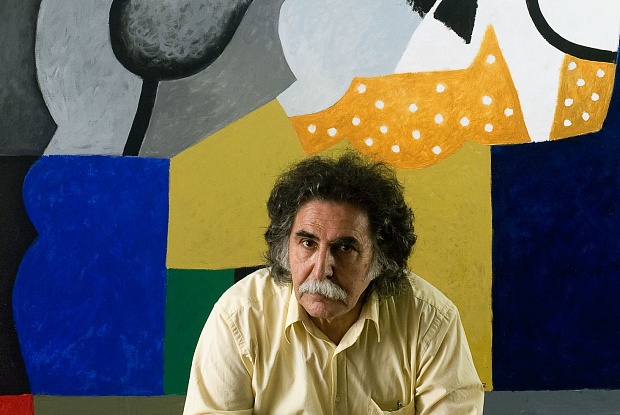
Qatar Museums (QM) is due to stage a major retrospective of the Iraqi Modernist artist Dia Al-Azzawi in October. The exhibition is believed to be the largest-ever solo exhibition of works by an Arab artist. Spanning two venues in Doha, Mathaf: Arab Museum of Modern Art and QM Gallery Al Riwaq, the exhibition will cover 9,000 sq. m and include 400 works.
Curated by Catherine David, the deputy director of the Centre Pompidou in Paris, the show includes works in a variety of media, including painting, sculpture, drawing, print and artist books, as well as original and limited editions of works on view for the first time. The two venues, across the city from one another, will highlight two different narratives in Al-Azzawi’s work. The first will focus on the artist’s use of image and text, and the other will trace the artist’s engagement with the political history of Iraq and the Arab world.


Al-Azzawi, who was born in Baghdad in 1939, has been a central figure in Iraq’s art scene. Before moving to London in 1976, where he continues to live and work today, Al-Azzawi was the director of the Iraqi Antiquities Department in Baghdad and an active member of the country’s emerging art groups at the time. “Al-Azzawi is considered one of the most important artists of the Arab world and for the first time a major retrospective will allow visitors to study the evolution of his practice and themes,” says Sultan Sooud Al-Qassemi, the founder of the Barjeel Art Foundation, whose collection features many works by the artist.
Alongside 90 works from the QM collection, the exhibition will feature loans from 17 private collections and four institutions, including the Barjeel Foundation, Sharjah; Centro de Arte Moderna Fundação Calouste, Lisbon; Kinda Foundation, Riyadh; and Tate Modern, London. The Tate is lending one of Al-Azzawi’s most renowned works, the vast mural Sabra and Shatila Massacre (1982-85). Often likened to Picasso’s seminal painting Guernica (1937), Al-Azzawi’s painting depicts the massacre of Palestinian refugees in 1982 during the civil war in Lebanon.
• I am the cry, who will give voice to me? Dia Al-Azzawi: a Retrospective (from 1963 until tomorrow), Mathaf: Arab Museum of Modern Art and QM Gallery Al Riwaq, Doha, Qatar, 16 October-16 April 2017
Originally published on The Art Newspaper.
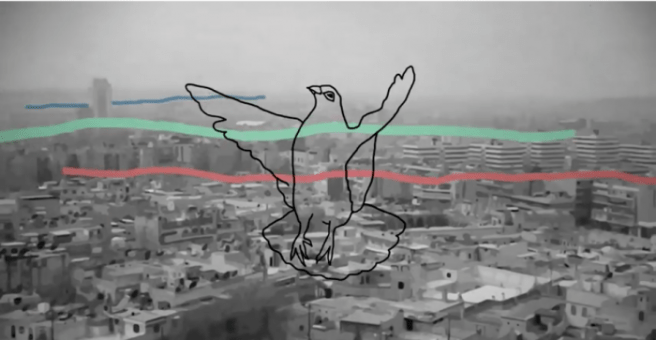
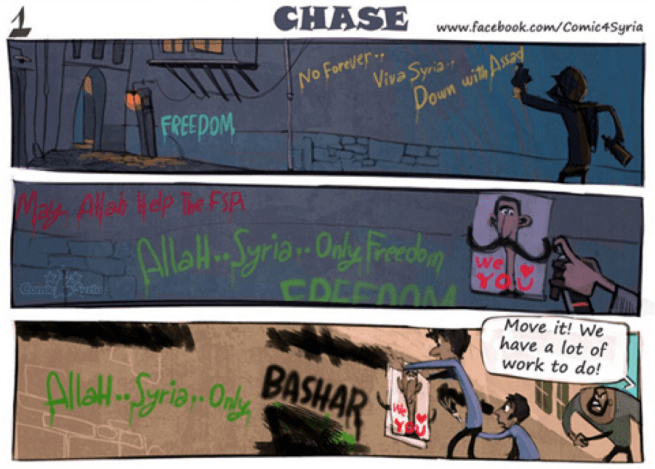 In 2011, a small piece of graffiti demanding the fall of the Syrian regime instigated a vicious crackdown by the government upon its young perpetrators. This graffiti was arguably one of the catalysts that led to the Syrian Revolution, which has since deteriorated into the now four-year-long civil war. It is somewhat fitting then that today, the cultural and artistic responses in the war-torn country have been described as the only positive development of the conflict. Despite the widespread devastation – which has seen over 230,000 people killed, more than 4 million fleeing as refugees, and almost 8 million internally displaced[1] – Syrians have been responding to and documenting their crisis creatively, taking advantage of greater freedom of expression of an essentially collapsed state (compared to the fierce censorship that reigned during Assad’s unchallenged rule). That is not to say that artists are free from the repercussions of their work – many artists have been forced out of work, threatened, beaten, imprisoned, forced to leave the country or, in some cases, killed[2]. In spite of the danger, and beyond the sounds of shelling and bombardments that try to drown them out, many artists both inside and outside the country continue to battle against tyranny to make their voices, and those of the Syrian people, heard.
 fanoffanoon.com